
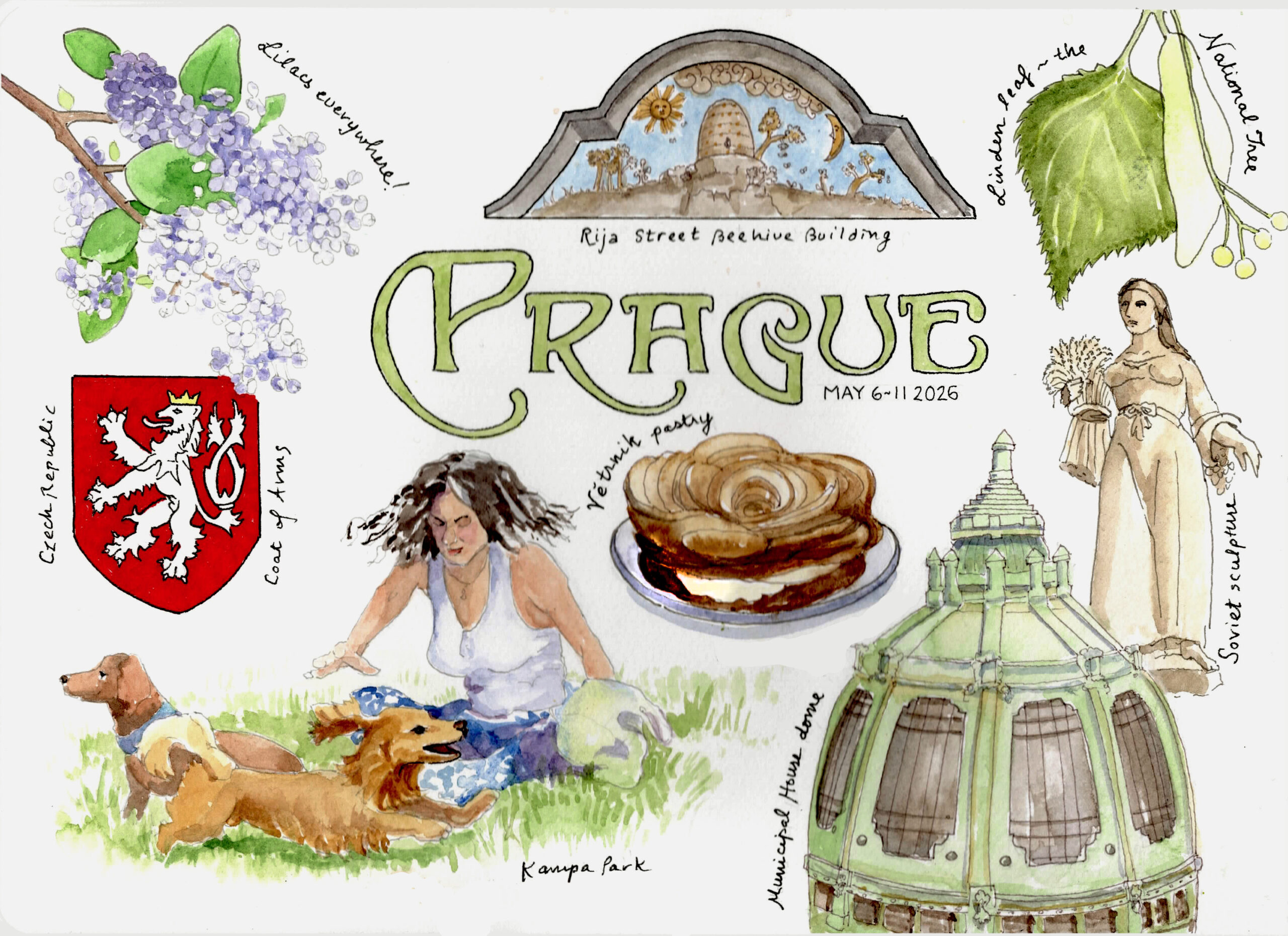

The city is as pretty as everyone had said it would be. Handsome Art Nouveau and Deco buildings line the cobbled streets. The Vitava river winds through gracefully. The weather couldn’t have been better: fresh spring leaves, lilacs and blooming European chestnut trees were everywhere.
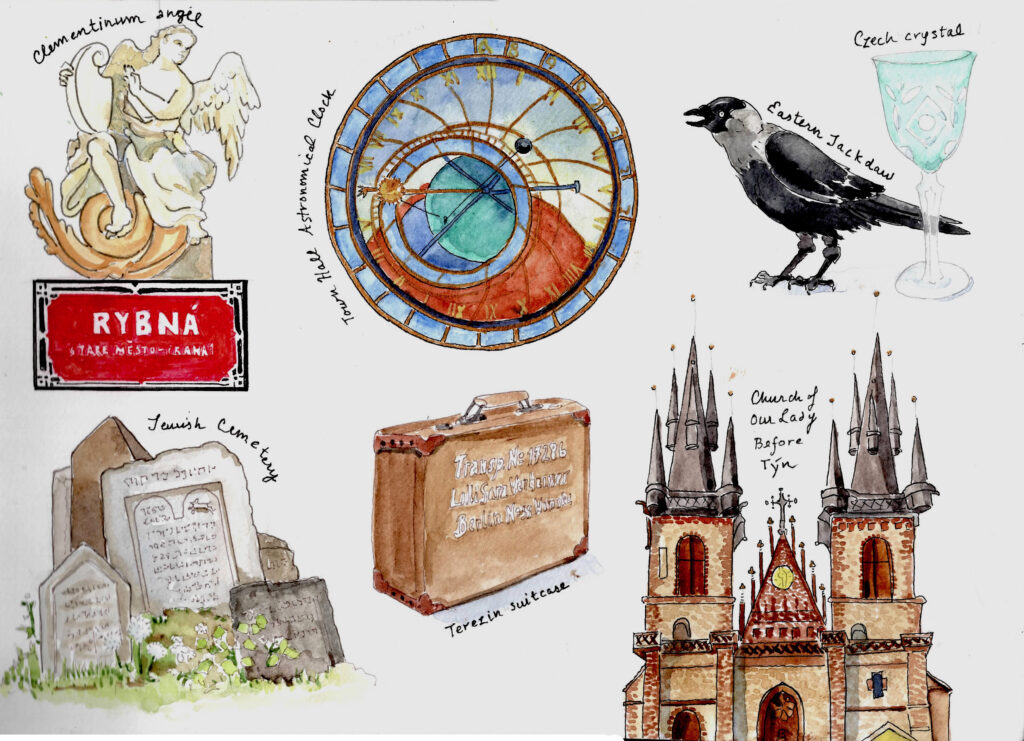
I, and a couple of old friends from San Francisco stayed in an elegant flat in the old town. Prague has several districts, and the picturesque center is called Staré Mesto (I can’t find the correct accent marks on my keyboard: the “e” in Mesto is to have a little “ˇ” over it). Right nearby is the old Town Square, an enormous plaza lined with decorative architecture of various historic periods. The Town Hall tower has a 16th-century astronomical clock which animates some religious figures and amusingly, has a mobile skeleton to ring the time. It draws strangling throngs of phone-wielding tourists on the hour. We battled our way through the crowds every time we returned to our apartment. The Old Town Square has dozens of touristy cafés, where mostly young visitors noisily imbibe the national drink, beer. Our neighborhood was saturated with souvenir shops selling identical tchotches, liquor and snacks. We had a hard time finding real food. Apparently the old center of town no longer houses normal folks.
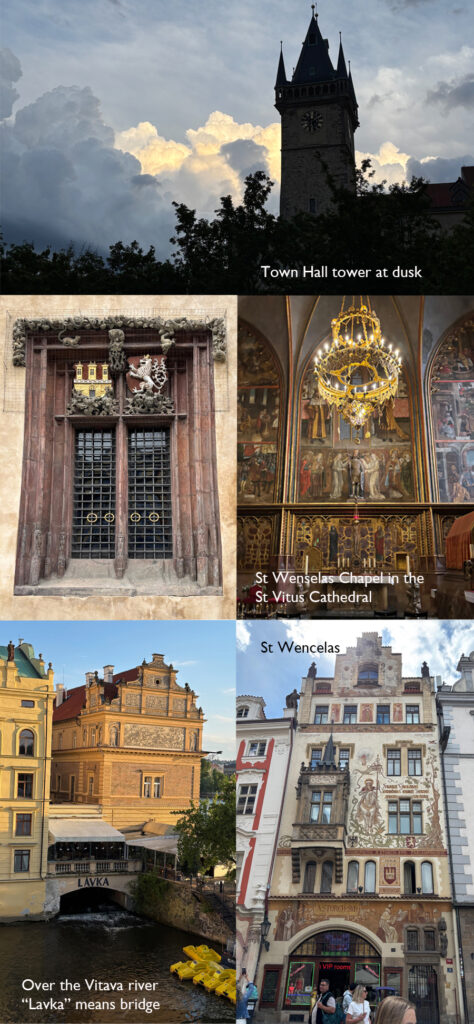
Behind the square is the beautiful Our Lady Before Tyn Church. Its echinated profile was designed in the 13th-century. Apparently the church became a center for the reform movement started by the martyred Jan Huss, whose mournful statue, along with representations of the victorious warriors who avenged his death (as well as his unfortunate followers who were expelled two centuries later), is on the north end of the square.
Northeast of the town square is the magnificent Municipal House, constructed in the early 1900s as a cultural center over the footprint of the 15th century Royal Palace. The style is appropriately flamboyant and joyous, as inside are the temples to pleasure: restaurants and concert halls. We ate at the Obecní Dom (again sorry: Czech accent marks aren’t available to me) which was opulently decorated with brass chandeliers and other Art Nouveau craftsmanship. The artist Mucha designed the interior of the huge dome.*
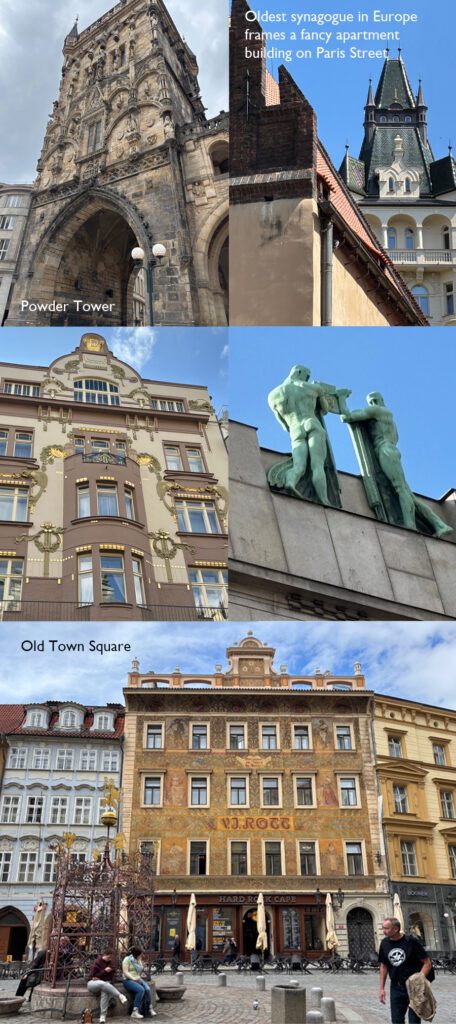
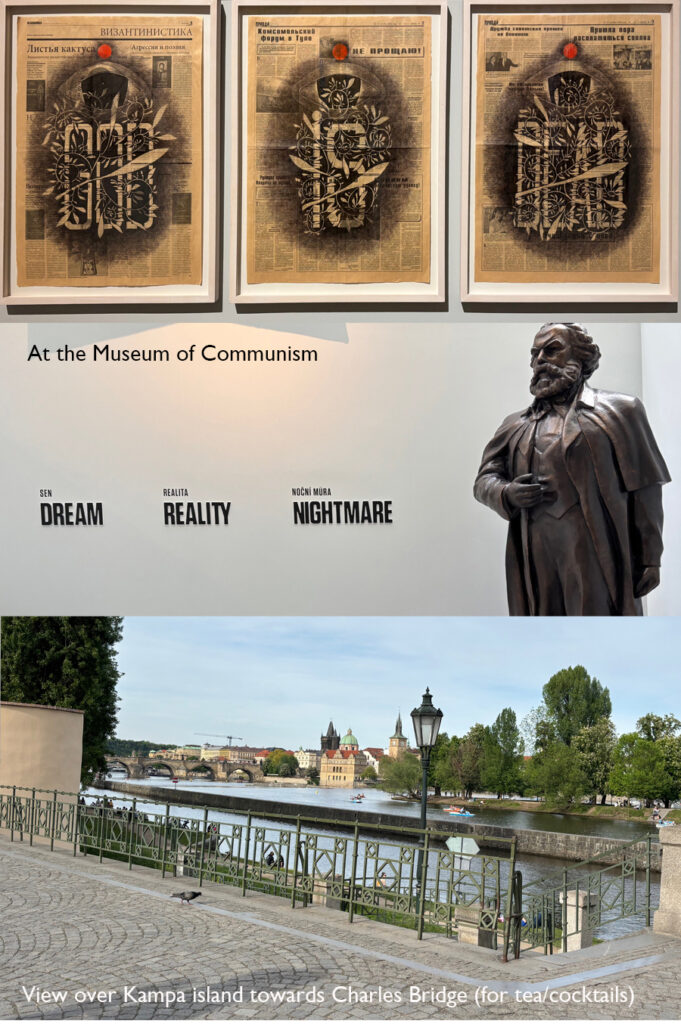
For a relics of a less happy period in Prague’s history visit the Museum of Communism adjacent to the Municipal House. I didn’t expect much, but the museum was fascinating—and huge. Because we had made lunch reservations at the Municipal House, we didn’t get to see the displays about post-Soviet Prague. We did examine many many documents, videos and artifacts from after 1948, when the “Iron Curtain” fell before the young Czechoslovak republic, as well as about the Soviet repression of the Prague spring 1968 until liberation in 1989.
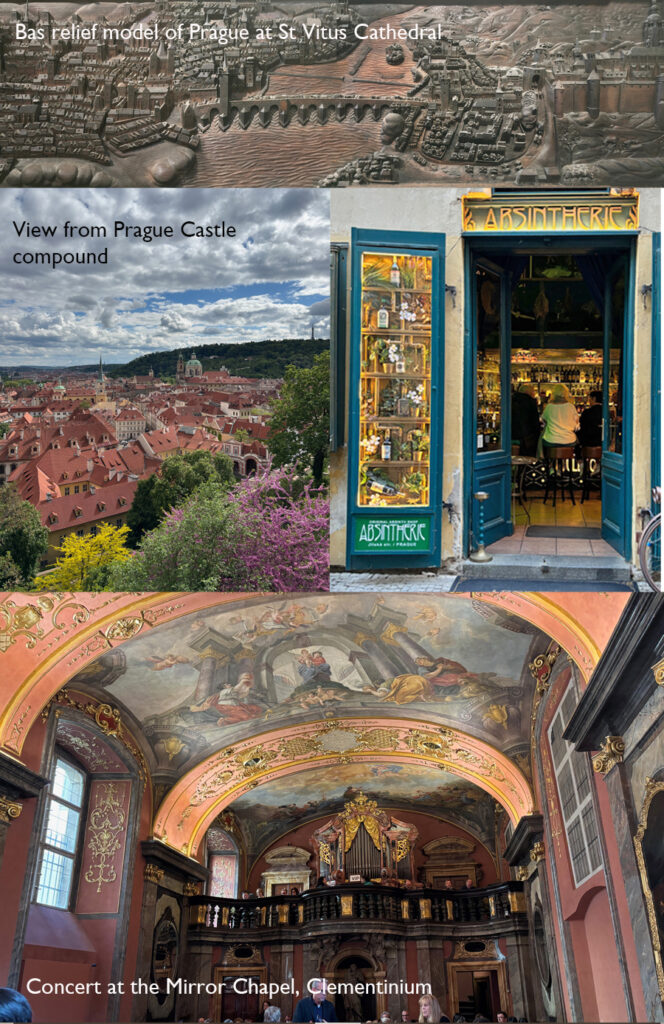
As I had been warned about tourist overload on the weekends, we chose to visit the castle complex on a weekday. I had hoped to take the funicular up to the top of Petrín Hill, but it wasn’t operating. Perched atop sits the palace, St. Vitus’s Cathedral, a couple of monasteries, huge gardens, and other sites of power. The district was immense and complicated to navigate, and we ended up just following an itinerary indicated by the ticket we bought, hence missing several of the widely scattered sites. We weren’t in the mood to explore the Castle Picture Gallery, and the monasteries were a bit out of the way. However, the best part of the Castle Complex was a tiny street called the “Golden Lane”, along which 16th century goldsmiths had their workshops. Naturally, proximity to all the pomp of palaces and cathedrals was handy for them. But even in the 20th century the diminutive houses were occupied, most notably one modest house providing Prague’s most famous writer, Franz Kafka, some peace and quiet away from downtown. (Those days of relief from the brouhaha of Staré Mesto sure are gone!) These humble abodes made me reflect on how lavishly I live. The views are terrific, looking down on the red-tiled roofs of the city, and we enjoyed a coffee beside the Palace vineyard.
A big part of our visit to Prague involved exploring the history of the Jewish people in Bohemia, and Prague in particular. We were staying right next to the old Jewish quarter and is was easy to walk the historic streets. Initially Prague’s Jews had freedom and rights, but in the 12th century, Prague’s Jews were confined to a ghetto. A hundred years later, the Bohemian king bequeathed them sanctuary as a quid pro quo for lending him money. And only a century after that, there was another genocide of the city’s Jews. The 16th-17th century was a particularly benign time attracting persecuted Jews from other lands. There even was a Jewish mayor, Mordecai Meisel, who helped finance the Bohemian war against the Ottomans (more quid pro quo…). But Empress Maria Teresa put an end to that in the mid 18th century. This pattern, of acceptance and integration, then violent pogrom, repeated itself through the Hapsburg period. In a cruel bit of absurdity, after the liberation of World War II the few returning German-speaking Jews suffered yet another expulsion when all German speakers were sent back to Germany.**
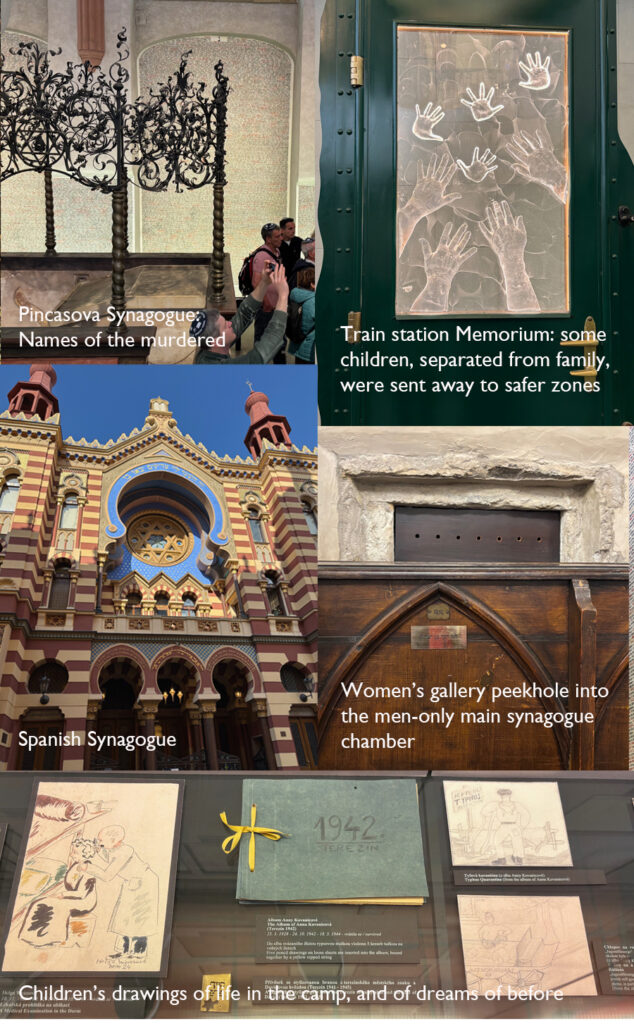
By the 19th century, the Jewish quarter was a crowded district with unsanitary conditions. All this was demolished and replaced with the handsome Art Nouveau buildings that we were able to see. Among them the old Jewish synagogues are sprinkled.
Of course, we are familiar with the nature of the Shoah, and the Terezin concentration camp was only 70 km away from town. This nasty and insalubrious camp was transformed into a show camp to demonstrate to the Red cross the benign rule of the Nazis. It was from there that men, women and kids were sent on to be murdered in the extermination camps such as Aushwitz.
Ironically, it was the Nazis who preserved Jewish artifacts they’d stolen from all over in order to create a “museum of a people gone”. The Jewish museum houses these pieces. On the walls of the Gothic-era Pincasova synagogue are written the names of the 77,297 Prague citizens who died in the camps. Also in that synagogue is a heartbreaking exhibit of children’s drawings, done in Terezin under the tutelage of an imprisoned art teacher, Friedl Dicker-Brandeis.
Adjacent to the Pinkasova Synagogue is the Old Jewish cemetery. To witness the jumble of gravestones is to feel the poignancy of the truth that Jewish Prague citizens were not permitted to bury their dead beyond a circumscribed lot during the years 1450 (maybe before)-1786. When there was no more room, they would haul over a pile of earth under which earlier graves were buried. Hence the ramshackle appearance, and the raised level of the cemetery in relationship to the street.
In a cheerier bit of our visit was our attendance at a concert given at the Clementinium. This splendid Baroque edifice houses the Mirror Chapel, where we heard an assortment of pieces played by members of the Czech philharmonic. The acoustics were great, and we heard some Dvorák and Smetena along with other classic hits. The subsequent ear-worms followed me around throughout my stay in Prague.
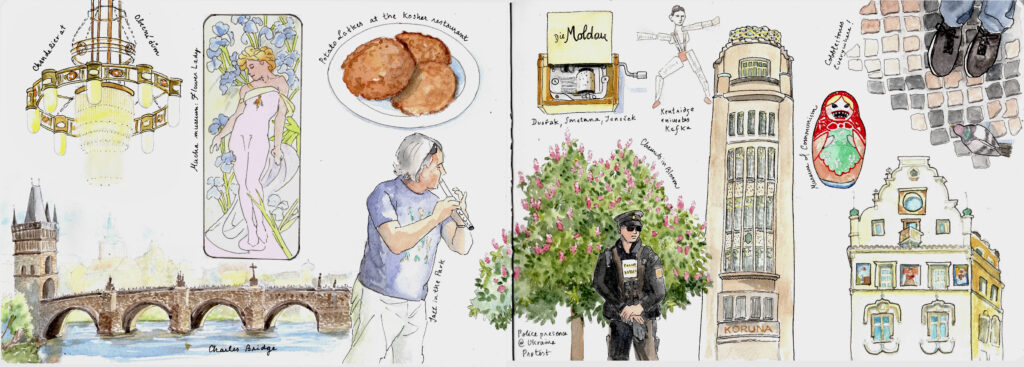
On another day, we ventured to the other side of the river to visit two Contemporary Art Museums: The DOX, and the Kunsthallepraha. The DOX, a cultural center created to celebrate contemporary art and discussion, is housed in a brutalist former factory. There we saw a show celebrating the art of collage. My disappointment in that museum was royally compensated at the Kunsthalle, where there was an extensive exhibit by the contemporary multi-disciplinary South African artist William Kentridge. We were entranced by the creativity demonstrated in the various videos. There was even a tiny moving shadow box devoted to Franz Kafka. Between the two museums is a lovely park above the river with lofty views of the other side.
I don’t think it was my imagination that made me feel the weight of history on this town. When we finally managed to walk on the famous (and heavily visited) Gothic Charles Bridge (named after Holy Roman Emperor Charles IV), I couldn’t help but have in my mind’s eye the image of the Nazis rolling across the Gothic structure in their tanks. Everywhere in the city were reminders of tragic moments in Prague’s history; so recent, too. I contrasted this with the relative carefree quality I feel in France and England (not to mention the United States, which has never experienced an invasion, other than that of our own European conquerors)
Along the river is the embankment of Kampa, in whose park we strolled on Sunday afternoon. Visitors and locals alike sprawled on the grass and listened to a local jazz group play. I found out that this island was submerged in the famous flood of 2002. The entire Old Town was evacuated and many historic buildings were severely damaged.
My last day was a bit truncated as I had to fly home, and was burdened with a suitcase. But I enjoyed a nice breakfast with a caramel-cream pastry and good coffee and had time to visit the Mucha museum too.
*The almost 80-year old Mucha died after being interrogated by the Gestapo in 1939
** Apparently, throughout Prague’s history, there was a class division between the upper-class, German speaking, and the less fortunate Czech speakers. Hence, as a lot of the Jewish population belonged to the educated classes, they were German speakers.


Thanks Diana for sharing your travel book with as always your beautiful illustrations and interesting descriptions. I like the choices of things you drew, it makes it all very personal and I can relate that way to what you experienced. I admire your writing skills, mixing touristic and historical facts in a light and profound discourse. It all urges me to go visit the town. I’m glad you enjoyed your trip 🙂
Love,
Cat
thank you Cathy, I enjoy putting all my impressions down before they fade away
Thanks Diana for your beautiful poetic scenery ! Sensible and clever story!!
Cheers!
Nicolas
Beautiful writing, illustration and photography Diana! Inspirational!